Article Summary
Verify bank statements with a 4-stage workflow: visual inspection, metadata checks, math reconciliation, and source confirmation. Plus a copy-paste checklist.
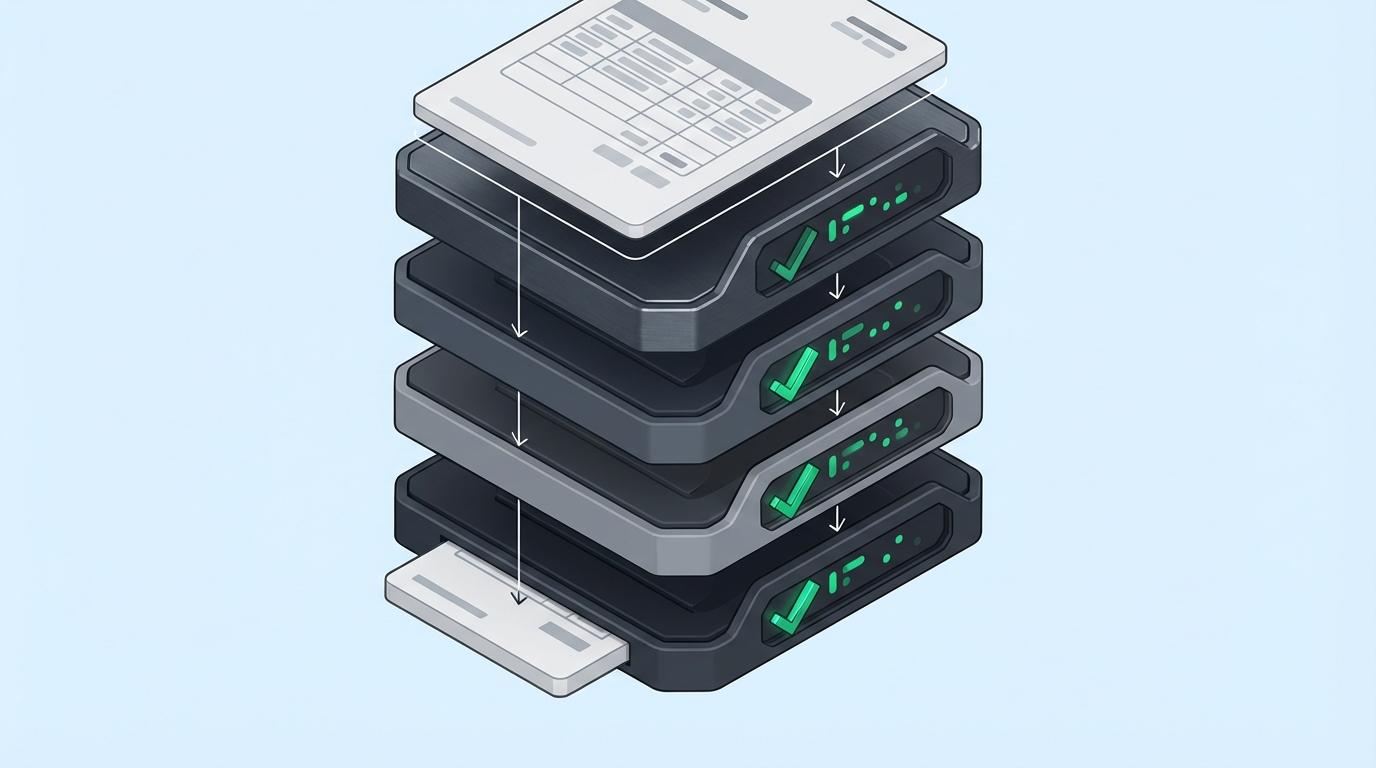
Bank statement verification follows four stages, each adding a layer of assurance before you act on the data in front of you. It starts with a visual inspection of formatting, logos, and layout consistency. Next, digital metadata checks examine PDF properties and creation timestamps for signs of tampering. Third, mathematical reconciliation tests whether individual transactions actually sum to the reported balances. Finally, source confirmation closes the loop by verifying the statement directly with the issuing bank.
These stages exist because bank statement fraud is a real and measurable problem. According to the 2025 Cotality Annual Fraud Report, an estimated 0.86% of all mortgage applications contain fraud risk, roughly 1 in every 116 applications, with income misrepresentation remaining the most common fraud finding at 46% of investigated cases through 2024. That statistic reflects mortgage underwriting alone. Landlords screening tenants, HR professionals verifying employment history, and auditors reviewing financial records face the same category of risk: decisions made on fraudulent statements carry consequences that range from financial loss to regulatory liability.
Most guides on how to verify bank statements present a flat list of methods without distinguishing which checks to run first or how deep to go. The bank statement verification process outlined here is structured differently. Four stages are organized by verification depth, so you can move from fast surface-level checks to progressively more rigorous analysis:
- Stage 1 -- Visual and Format Inspection catches the most obvious red flags in seconds: font inconsistencies, misaligned columns, incorrect logos, and formatting errors that off-the-shelf editing tools typically leave behind.
- Stage 2 -- Digital Metadata and Document Forensics examines the PDF file itself, including creation software, timestamps, and embedded properties that are difficult to fake convincingly.
- Stage 3 -- Mathematical Reconciliation tests the internal arithmetic of the statement, verifying that opening balances, transactions, and closing balances actually add up.
- Stage 4 -- Source Confirmation eliminates remaining uncertainty by validating the statement against records held by the issuing institution.
Whether you are underwriting a mortgage, approving a lease application, or conducting a financial audit, this workflow gives you a repeatable, structured approach to bank statement verification. The fastest and most accessible check is visual inspection, and that is where Stage 1 begins.
Stage 1: Visual and Format Inspection
Visual inspection is the first line of defense in bank statement verification because it requires no specialized tools and can flag crude forgeries within seconds. Before running any calculations or contacting a bank, a careful eye can catch the most common signs of tampering or outright fabrication.
Here are the specific checks to perform on every statement that crosses your desk.
Logo quality and placement. Authentic bank statements feature crisp, high-resolution logos positioned consistently on every page. Compare the logo against the bank's current branding on their official website. Forged statements often use logos that are slightly pixelated, outdated, or shifted from their standard position. A logo that looks like it was copied from a low-resolution web image is an immediate red flag.
Font consistency. Legitimate bank statements use a single, consistent font family throughout the document. Every transaction description, every date, every balance figure will share the same typeface and sizing conventions. If you spot mixed fonts, unexpected bold or italic variations within the same field type, or subtle differences in character spacing between lines, the document has likely been edited. Pay particular attention to the digits in balance and transaction amount fields, where alterations are most common.
Alignment and spacing. Check for uneven margins, inconsistent line spacing between transactions, or text that sits slightly higher or lower than surrounding elements on the same line. Banks generate statements programmatically, which produces uniform spacing throughout. Manual edits almost always disrupt this uniformity, even when the forger is careful. Zoom in to 200% or higher on digital documents to make subtle misalignments visible.
Header and footer consistency. Compare headers and footers across every page of a multi-page statement. Then compare them across multiple months from the same bank. Authentic statements maintain identical header and footer formatting, page numbering conventions, and disclaimer text. Discrepancies between pages of the same statement are especially telling, since they suggest pages were assembled from different source documents.
Paper quality and printing (for physical documents). When reviewing printed statements, check for differences in paper stock, weight, or texture between pages. Run your finger across printed text to feel for inconsistencies in toner application. Forged pages inserted into an otherwise authentic statement often betray themselves through subtle differences in print density or paper feel.
Account number and sort code format. Every bank follows specific formatting patterns for account numbers and sort codes. Verify that the numbers on the statement match the bank's known conventions for digit count, grouping, and placement. The same principle of identifying key fields and red flags in financial documents applies to bank statements just as it does to invoices and other financial records. An account number with the wrong number of digits or an unfamiliar sort code prefix warrants immediate scrutiny.
Visual inspection catches amateur forgeries, but it has a clear limitation: sophisticated fakes use authentic bank templates, correct fonts, and proper formatting. A statement that passes every visual check above may still be fabricated. Checking if a bank statement is real requires going deeper than what the eye can see.
What most people do not realize is that every digital bank statement carries hidden information about its own creation. The PDF file itself records when it was made, what software produced it, and whether anyone has modified it since.
Stage 2: Digital Metadata and Document Forensics
Visual inspection catches surface-level inconsistencies, but every PDF carries a hidden layer of information that reveals far more about its origins. This metadata records when the document was created, what software produced it, and whether it has been modified since generation. None of this is visible on the printed page, but it is accessible in seconds using Adobe Acrobat's "Document Properties" panel or free PDF analysis tools.
Metadata analysis is a critical component of any bank statement verification process because it exposes alterations that leave no visible trace.
Creation and Modification Dates
A legitimate bank statement's creation date should align with the statement period. Banks typically generate statements within a few days of the period's close. If you receive a statement dated January 2026 but the PDF's creation metadata shows it was produced in March 2026, that gap warrants further investigation. The modification date matters too: a document that was created once and never modified is more trustworthy than one showing multiple edits after initial generation.
Producer Software
The "Producer" and "Creator" fields in PDF metadata identify the software that generated the file. Bank-produced statements typically show proprietary banking platforms, enterprise document management systems, or institutional PDF generators. When these fields instead show Adobe Acrobat Pro, Microsoft Word, Canva, or online PDF editing tools, the document was likely recreated or altered outside the bank's systems. This single check eliminates a large percentage of amateur forgeries.
Digital Signatures
Some banks digitally sign their PDF statements using cryptographic certificates. A valid, unbroken digital signature tied to the issuing bank is strong evidence of authenticity because any modification to the signed content invalidates the signature automatically. An absent signature is not proof of fraud, since not all banks sign their statements. But a broken or invalid signature on a document that claims to be digitally signed is a serious red flag that the content was altered after the bank issued it.
Compression Artifacts and Image Analysis
For scanned or image-based bank statements, examine the document for inconsistent compression levels. When someone edits a scanned PDF and re-saves it, the altered regions often show different compression artifacts or resolution levels compared to the original content. Look for text blocks that appear sharper or softer than surrounding elements, or areas where the background texture shifts abruptly. These visual-digital inconsistencies indicate that portions of the document were modified after the initial scan.
Font Embedding
Legitimate bank PDFs embed their fonts consistently throughout the document. Every character on every page uses the same embedded typeface because the entire document was generated in a single automated process. If your PDF analysis reveals that some text uses embedded fonts while other sections rely on system-substituted fonts, parts of the document were likely added or replaced using different software. This applies a similar principle to the structured validation process for financial documents used in accounts payable, where font consistency serves as a reliable authenticity indicator.
The Limits of Metadata Analysis
Metadata checks are a strong verification layer, but they are not conclusive on their own. Sophisticated actors can strip metadata entirely, spoof creation dates, or use tools that mimic bank-generated PDF properties. Treat metadata analysis as one stage in your workflow rather than a standalone verdict. A document that passes metadata checks still needs further validation, and one that fails may deserve additional scrutiny rather than immediate rejection.
A statement can pass both visual and metadata inspection and still contain fabricated figures. Consider a forger who starts with a genuine bank statement PDF, leaves the formatting and metadata intact, but edits three deposit amounts to inflate apparent income. Nothing in Stages 1 or 2 would catch that. The numbers themselves need to be tested.
Stage 3: Mathematical Reconciliation
Visual inspection and metadata forensics catch surface-level tampering, but they miss a category of fraud that only math can reveal. A legitimate bank statement obeys an inviolable equation: the opening balance plus all deposits minus all withdrawals equals the closing balance. This arithmetic fact cannot be faked without altering every transaction record in the statement. For a single month, you can verify this by hand in 15-20 minutes. But mortgage applications typically require 12-24 months of statements, and quarterly audit reviews can span even longer periods. At that scale, manual calculation becomes unreliable.
Extract, Then Verify
The reconciliation process starts with converting raw PDF data into structured, calculable form. Extract every transaction from the bank statement into a spreadsheet or CSV file, capturing the date, description, debit amount, credit amount, and running balance for each line item. Once you have structured data, run two tests:
Per-month balance verification. For each statement period, confirm that:
Opening balance + sum of all credits/deposits - sum of all debits/withdrawals = closing balance
Any discrepancy, even by a single cent, indicates the statement has been altered.
Cross-month carry-over test. The closing balance of month 1 must exactly equal the opening balance of month 2, and so on through the entire statement set. Fraudsters who edit individual months often fail to maintain continuity across the full sequence, especially when manipulating 12 or more consecutive statements.
What Mathematical Reconciliation Catches
This approach exposes manipulation patterns that visual and metadata checks cannot detect:
- Selectively deleted transactions. Removing a withdrawal to inflate an apparent balance causes the monthly totals to stop reconciling.
- Inflated deposit amounts. Editing a deposit from $2,400 to $4,400 breaks the running balance chain unless every subsequent balance is also recalculated, which most forgers fail to do consistently.
- Round-number fabrication. Legitimate transactions follow natural distribution patterns. Statements padded with deposits of exactly $5,000 or $10,000 exhibit statistical anomalies that structured data analysis can flag.
For a deeper look at reconciliation methods for matching transactions against records, the same principles apply whether you are verifying bank statements or cross-referencing invoices against payment records.
Benford's Law as a Fraud Signal
In naturally occurring financial data, the leading digit of transaction amounts follows a predictable distribution known as Benford's Law. The digit 1 appears as the leading digit roughly 30% of the time, while 9 appears only about 5% of the time. This pattern holds across legitimate bank statements, tax filings, and accounting ledgers.
Fabricated transaction data tends to show unnaturally uniform leading-digit distributions. People inventing numbers gravitate toward digits like 5, 6, and 7 far more often than real transactions would. Running a Benford's Law analysis on your extracted transaction data adds a statistical layer of verification: if the leading-digit distribution deviates significantly from the expected curve, that statement set warrants closer scrutiny.
Solving the Extraction Bottleneck
The math itself is straightforward. The bottleneck is getting transaction data out of PDF bank statements and into a format where you can actually run calculations. Manually keying in hundreds of transactions per month across a 24-month statement set introduces the very errors you are trying to detect.
Platforms built for financial document extraction solve this bottleneck. Invoice Data Extraction, for example, processes PDF bank statements (including scanned documents) and outputs structured Excel or CSV files, letting you extract and verify bank statement data automatically. You can prompt the AI with specific instructions such as "Extract all transactions with date, description, debit, credit, and running balance." Batch processing handles up to 6,000 documents per job, which means an entire loan file's worth of bank statements can be extracted in a single pass rather than keyed in by hand over several hours.
With your transaction data extracted and reconciled, you have strong mathematical evidence of whether the statements are genuine. For many routine verifications, Stages 1 through 3 provide sufficient confidence. But when the stakes are highest -- a six-figure mortgage approval, a contested legal matter -- there is one more option: going directly to the bank that issued the statement.
Stage 4: Source Confirmation
Source confirmation is the most definitive method to verify bank statement authenticity. Unlike the previous three stages, which analyze the document itself, this stage bypasses the document entirely. You confirm the underlying financial information directly with the institution that generated it. No level of forgery sophistication can survive a direct check with the issuing bank.
Contact the Issuing Bank Directly
Call the bank using a phone number you source independently from the bank's official website. Never use a contact number printed on the statement you are verifying. A forged document can include a fake phone number that routes to an accomplice ready to "confirm" fabricated details.
When you reach the bank, request verbal confirmation of:
- Account existence under the named account holder
- Balance ranges for the period shown on the statement
- Account type (checking, savings, business) matching the statement
Banks will not disclose exact transaction details over the phone without proper authorization, but they can typically confirm whether an account is active and whether stated balances fall within a reasonable range.
Request a Bank Verification Letter
A bank verification letter (BVL) is a formal document issued by the bank confirming account details, balances, and in some cases transaction history for a specified period. BVLs carry the bank's institutional authority and are standard practice in mortgage underwriting, legal proceedings, and audit engagements.
To obtain one, the account holder must authorize the bank to release the information. The request typically goes through the bank's branch or commercial banking team, and the letter is sent directly from the bank to the requesting party, which eliminates the account holder as an intermediary who could alter the document.
Open Banking and API Verification
Where available, open banking APIs offer the fastest and most tamper-proof method to verify bank statement data. Under frameworks like PSD2 in the UK and EU, authorized third parties can access account data directly from the bank's systems with the account holder's consent. This approach is growing in other markets as well.
Open banking verification eliminates the paper document from the process entirely. You read account balances and transaction histories straight from the bank's database through a secure API connection. There is no PDF to forge, no metadata to manipulate, and no numbers to alter. For organizations that process high volumes of bank statement authentication requests, API-based verification scales in ways manual checks cannot. Several third-party fintech services also specialize in bank account verification, combining open banking connections with their own infrastructure to offer a single integration point across multiple banks and regions -- particularly useful when you need to verify bank statements online across a variety of institutions.
Practical Limitations
Source confirmation is thorough, but it is not instant. A bank verification letter can take several business days to process. Direct phone verification requires navigating bank call centers during business hours. Open banking access requires the account holder's active consent through a digital authorization flow, and not all banks or regions support it yet.
This is precisely why source confirmation sits at Stage 4 rather than Stage 1. The visual inspection, metadata forensics, and mathematical reconciliation stages filter out fraudulent documents before you invest time and effort in source verification. By the time you reach Stage 4, you are confirming documents that have already passed three layers of scrutiny, which means you are spending verification resources only on documents that warrant the investment.
The specific checks you prioritize within each stage depend on your professional context and regulatory requirements. A mortgage lender, a landlord screening tenants, and an auditor conducting a financial review each face different risk profiles and compliance obligations.
What Changes by Use Case: Lenders, Landlords, Auditors, and More
The 4-stage workflow provides the universal framework, but the depth and emphasis at each stage shifts based on who you are and what decision the bank statements inform. A mortgage underwriter verifying 24 months of income history operates under different constraints than a landlord screening a rental applicant with three months of statements. An auditor confirming account balances for a year-end audit has yet another set of priorities.
Here is how each role adapts the workflow.
Lenders: Mortgage Officers and Loan Underwriters
Typical requirement: 12-24 months of bank statements.
Bank statement verification for lenders centers heavily on Stage 3 (mathematical reconciliation) because the core task is income verification over an extended period. You are not just confirming that a document is authentic -- you are cross-referencing deposit amounts against pay stubs, tax returns, and employer verification letters across the full 12-24 month window.
Priority checks for lending:
- Employment deposit alignment. Verify that regular deposits match the stated employment in both frequency (biweekly, semi-monthly, monthly) and amount. A borrower claiming $85,000 annual salary should show deposits consistent with that figure after tax withholdings.
- Large unexplained deposits. Any deposit that falls outside the pattern of regular income requires explanation. These could indicate undisclosed debts, gift funds requiring donor letters, or asset transfers that affect the borrower's financial picture. Fannie Mae and Freddie Mac guidelines specifically require documentation of large deposits.
- Debt-to-income calculation. Extract recurring payment obligations visible in the statements -- loan payments, credit card payments, alimony -- and calculate them against verified income. This is where accurate data extraction across dozens of pages directly affects underwriting accuracy.
Regulatory context: Fannie Mae and Freddie Mac guidelines impose specific documentation standards for bank statement verification. If verification reveals indicators of fraud -- fabricated statements, manipulated figures, identity inconsistencies -- FinCEN reporting obligations apply.
Volume challenge: 24 months of statements can mean 24 or more separate documents across multiple accounts. Running batch processing through Stages 1-3 before selectively applying Stage 4 (source confirmation) to flagged items is the practical approach. Reviewing every page manually at full depth is neither scalable nor necessary when the initial stages filter effectively.
Landlords and Property Managers
A tenant submits three months of bank statements showing $6,500 in monthly income for a $2,000/month apartment. The standard threshold is income at 2.5-3x the monthly rent, so the numbers appear to clear. But bank statement verification for landlords goes beyond a single income figure.
Start with Stage 1 (visual inspection) on every application. Then focus on Stage 3 (income verification): look for consistent employment deposits appearing regularly across all three months -- irregular or missing deposits warrant follow-up questions. Check for patterns of overdrafts, negative balances, or returned payments, which reveal cash flow problems that monthly income figures alone do not capture. Reserve Stage 2 (metadata forensics) and Stage 4 (source confirmation) for borderline cases.
Landlords and property managers often process many applications during peak leasing periods. A streamlined approach -- visual check plus income calculation -- handles the majority of cases. Reserve the full 4-stage workflow for applications where something looks off: formatting inconsistencies, income that barely meets the threshold, or gaps in deposit patterns.
Auditors
Typical requirement: Full audit period statements (quarterly, annually, or custom engagement period).
Auditors weight the workflow differently than either lenders or landlords. The emphasis falls on Stage 3 (completeness testing) and Stage 2 (metadata verification to confirm document provenance). The question is not "can this person afford a payment?" but "do these statements represent a complete and unaltered record of all transactions for the period?"
Priority checks for audit engagements:
- Completeness testing. Are there gaps in statement dates? Does the ending balance of each month match the opening balance of the next? Missing periods in the statement sequence can conceal transactions that would affect the audit opinion.
- General ledger reconciliation. Cross-reference statement transactions against the client's general ledger entries. Discrepancies between bank records and book records are where material misstatements surface.
- Related-party transaction testing. Flag transfers to or from entities connected to management or owners. These require separate disclosure and verification under professional audit standards.
Professional standards context: Audit standards require documented evidence of the verification procedures performed, including what was tested, what was found, and how exceptions were resolved. Your verification workflow needs to produce a defensible audit trail, not just a pass/fail conclusion.
HR Professionals and Legal Teams
Two additional roles encounter bank statement verification regularly, though with narrower scope. HR professionals verifying employment or income typically review 1-3 months of statements and focus on Stage 3: confirming that deposit amounts align with the salary the candidate or employee claims. The key check is whether regular deposits match the stated compensation in frequency and amount after expected deductions.
Legal professionals handling litigation, divorce proceedings, or asset disputes face a different priority: chain of custody. Every verification step must be documented in a way that is defensible in court. Stage 2 (metadata analysis) and Stage 4 (source confirmation via bank verification letters) carry extra weight because opposing counsel can challenge the authenticity of any document introduced as evidence. Digital verification records and BVLs from the issuing bank provide the strongest evidentiary foundation.
Regardless of your specific use case, there are situations where verification reveals problems -- altered documents, unexplained discrepancies, or confirmed fraud. Knowing how to respond when verification fails is as important as the verification process itself.
When Bank Statement Verification Fails
Discovering a potentially fraudulent or altered bank statement triggers specific obligations that vary by your role, industry, and jurisdiction. How you respond in the hours after detection matters as much as the detection itself. Acting correctly protects both you and your organization from legal exposure.
Document Everything First
Before taking any other action, preserve the evidence. Save the original document exactly as received -- do not annotate, highlight, or alter it in any way. Record which verification stage flagged the issue (visual inspection, metadata analysis, mathematical reconciliation, or source confirmation) and note every specific discrepancy you identified. Include timestamps showing when you received the document and when you detected the problem.
This documentation serves two purposes: it supports any future legal proceedings or regulatory filings, and it demonstrates that your organization followed a defensible verification process.
Do Not Confront the Applicant
The natural impulse is to ask the applicant directly, but this can backfire. Confronting someone about suspected fraud can prompt them to destroy additional evidence or coordinate explanations before a formal investigation begins. Follow your organization's internal procedures before any external communication about the findings.
Escalate Internally
Report your findings to your compliance department, legal team, or direct supervisor -- whoever your organization's fraud response procedures designate. Most regulated businesses have established escalation paths for exactly this scenario. If your organization lacks a formal fraud response procedure, route the report to legal counsel.
Fulfill Reporting Obligations
Certain professionals carry mandatory reporting requirements:
- Financial institutions must file Suspicious Activity Reports (SARs) with FinCEN when they detect known or suspected violations of federal law or suspicious transactions. Bank statement fraud tied to a loan application falls within this scope.
- Mortgage industry professionals operating under federal guidelines face specific reporting timelines that vary by agency and program.
- Landlords, employers, and other professionals without mandatory reporting obligations should still consider filing a report with local law enforcement, particularly when the fraud appears to be part of a broader pattern.
Failure to file required reports carries its own penalties, separate from any liability related to the underlying fraud.
Reject the Application
A failed verification provides sufficient grounds to deny the application -- whether for a loan, a lease, or employment -- regardless of whether fraud is ultimately proven. You are not required to demonstrate intent or build a criminal case. Your standard is straightforward: the documentation submitted does not meet your verification requirements.
Communicate the denial through your standard rejection process. You are generally not required to disclose the specific verification failures, though applicable laws (such as adverse action notice requirements under the Fair Credit Reporting Act for certain use cases) may dictate what you must include.
Maintain Your Records
Retain all documentation of the verification process, the flagged discrepancies, your internal escalation steps, and any regulatory filings. Follow your organization's data retention policies, and be aware that any active investigation or legal proceeding may impose a legal hold that overrides standard retention schedules.
Account for False Positives
Not every red flag indicates fraud. A formatting inconsistency might reflect a bank's system migration or template update rather than document tampering. A rounding difference of a few cents could stem from the institution's own calculation methods.
This is precisely why the four-stage workflow matters. A single anomaly in one stage warrants deeper investigation, not automatic rejection. When multiple failures appear across two or more stages -- a font inconsistency combined with a metadata timestamp mismatch and a running balance that does not reconcile -- the probability of a legitimate explanation drops sharply.
Having a structured, repeatable verification process protects you in both directions: it catches genuine fraud through systematic analysis, and it prevents hasty rejections based on isolated quirks. The final step is consolidating this entire workflow into a reference you can use on every statement that crosses your desk.
Bank Statement Verification Checklist
The four-stage workflow above covers the reasoning behind each verification step. This checklist distills it into a portable reference you can apply to every bank statement that crosses your desk.
Stage 1 -- Visual and Format Inspection:
- Bank logo is crisp, correctly placed, and matches current branding
- Font family and sizes are consistent throughout the document
- Text alignment and spacing are uniform
- Headers and footers are consistent across pages and across months
- Account number and sort code formats match the bank's known patterns
Stage 2 -- Digital Metadata Checks:
- PDF creation date aligns with the statement period
- Producer software is a bank system or enterprise document platform (not consumer editing tools)
- Digital signature is present and valid (if the bank typically signs statements)
- Font embedding is consistent throughout the document
- No signs of inconsistent compression or resolution in image elements
Stage 3 -- Mathematical Reconciliation:
- Opening balance + deposits - withdrawals = closing balance (for each month)
- Closing balance of month N = opening balance of month N+1
- Deposit amounts match supporting documents (pay stubs, contracts, tax filings)
- Transaction amounts follow natural distribution patterns (Benford's Law test, if available)
- No unexplained round-number deposits or suspicious clustering
Stage 4 -- Source Confirmation:
- Bank contact information verified independently (not from the statement itself)
- Bank contacted to confirm account existence and balance range
- Bank verification letter requested (for high-stakes decisions: mortgages, legal proceedings)
- Open banking / API verification used where available
A structured verification process protects your organization from fraud and demonstrates due diligence. Not every statement requires all four stages -- visual inspection and mathematical reconciliation handle most routine verifications, while digital forensics and source confirmation are reserved for high-value decisions or when earlier stages raise concerns.
Related Articles
How to Convert Bank Statement to Excel (5 Methods Compared)
Compare 5 methods to convert bank statement PDFs to Excel or CSV. Covers direct download, Excel Power Query, copy-paste, converter tools, and AI extraction.
Bank Statement Analysis: A Practitioner's Guide for Accountants
Learn how to analyze bank statements with a five-step framework, worked examples, multi-period trends, and scaling guidance for accounting practitioners.
Bank Statement Reconciliation: A Complete Guide
Step-by-step bank statement reconciliation with a worked numerical example, extraction prerequisite, failure diagnosis, and volume-tiered guidance.
Extract invoice data to Excel with natural language prompts
Upload your invoices, describe what you need in plain language, and download clean, structured spreadsheets. No templates, no complex configuration.